
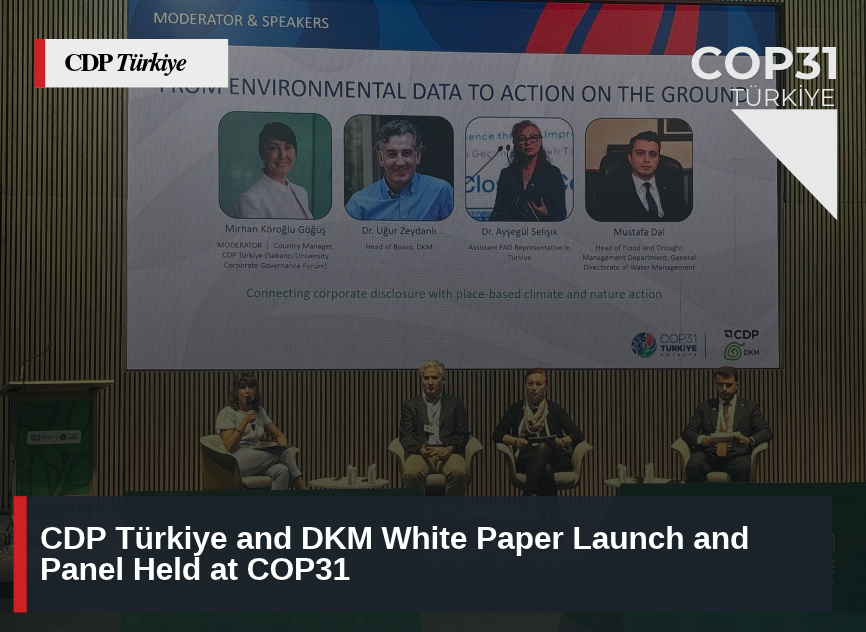
On 19 November 2026, at an event held as part of COP31 in Antalya, the joint white paper “From Environmental Data to Action on the Ground: Connecting Corporate Disclosure with Place-Based Climate and Nature Action”, prepared by CDP Türkiye / Sabancı University Corporate Governance Forum and the Nature Conservation Centre (DKM), was released. The event discussed how corporate environmental reporting on climate change, water security, biodiversity and ecosystem management should be translated into concrete, measurable action on the ground.
Mirhan Köroğlu Göğüş, Country Manager of CDP Türkiye, presented the main findings of the white paper and moderated the panel. The speakers were Dr. Uğur Zeydanlı, Head of Board of DKM; Dr. Ayşegül Selışık, Assistant FAO Representative in Türkiye; and Mustafa Dal, Head of the Flood and Drought Management Department at the General Directorate of Water Management.
The publication brings together three sources: the reporting of 151 companies featured in the CDP Türkiye 2025 Climate and Nature Report, DKM’s field experience from nearly 200 projects, and insights from two webinars held ahead of COP31 (29 September on climate and water security, 26 October on biodiversity and forests). Focusing on five themes (climate change, water security, biodiversity, forests and plastics), the study finds that companies have made significant progress in identifying risks, measuring performance and setting targets, but that the extent to which this progress improves the condition of ecosystems is not always adequately tracked.
According to the study, companies are most advanced on climate change, in terms of management systems and emissions measurement. Water security is a different picture: 82% of the companies reporting on water security withdraw water from water-stressed regions. This high exposure to risk has driven progress in their water management. At the same time, although the share of companies setting targets is high, only 1% set targets at the basin level. The share of companies using biodiversity indicators is 32%. The publication also shows, with examples, that the right intervention depends on local conditions: in agricultural regions such as Konya and Harran, water efficiency must be considered not only through irrigation technology but together with soil management and basin conditions; in fire-affected forests, replanting is not always the best solution, and supporting natural regeneration can sometimes be more effective.
The panel discussed the importance of grounding environmental interventions in scientific data and local conservation priorities, addressing water security at the basin scale, and the relationships between agricultural production, ecosystem health and local livelihoods.
The common thread of the discussions was aligning companies’ environmental targets with local ecological conditions and strengthening long-term cooperation among public institutions, the scientific community, business and local communities.
The publication addresses, with concrete examples, how environmental activities do not produce the same ecological outcome in every context.
The white paper sets out five priorities for turning data into concrete results on the ground: using data to identify where intervention is most needed; extending environmental management to supply chains and nature-related impacts; linking investments to basin- and landscape-scale priorities; measuring and monitoring outcomes over the long term; and strengthening lasting partnerships. Closely linked to COP31’s focus on implementation and resilience, the study underlines that the value of environmental reporting lies not only in the data produced, but in how well that data supports better decisions and measurable ecological improvement.
The full white paper is available here.