
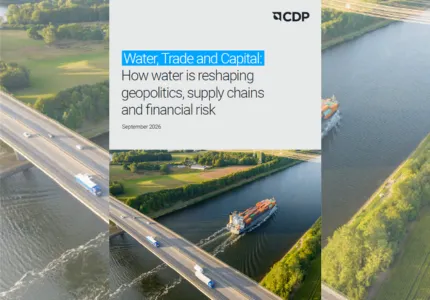
CDP’s new report highlights the growing impact of water on global supply chains, economic competitiveness and financial risk.
The new report, “Water, Trade and Capital: How Water is Reshaping Geopolitics, Supply Chains and Financial Risk,” highlights that water is no longer only an environmental issue. It is becoming an increasingly important factor for corporate supply chain resilience, production decisions, economic competitiveness and strategic autonomy.
The report shows that the global economy relies on long and complex supply chains that are ultimately dependent on water, natural resources and specific geographic conditions. As climate change, water scarcity, geopolitical tensions and shifts in global supply chains intensify, access to reliable water is becoming increasingly important for business and investment decisions.
According to CDP data, companies anticipate US$397 billion in future financial impacts from water-related disruptions, including US$45 billion arising upstream in supply chains. At the same time, around one in three companies reporting on water through CDP do not yet have a process in place to identify, assess and manage water risks.
The report also highlights that water risks extend far beyond companies’ direct operations, travelling through supplier relationships, trade routes and global value chains. In 2025, 78% of companies reporting on water to CDP reported that they map or plan to map their supply chains. However, three-quarters of these companies only map as far as their direct suppliers, leaving significant upstream water risks unmeasured and unmanaged.
Beyond risks, the report identifies significant opportunities linked to water. Companies report US$35 billion in water-related opportunities already having a substantive financial or strategic impact, with a further US$925 billion anticipated in the future.
The report emphasizes the growing strategic value of water and highlights the importance of understanding water dependencies, assessing risks and strengthening resilience across supply chains. As access to reliable water becomes increasingly linked to competitiveness and economic development, companies that better understand and manage their water-related dependencies will be better positioned to navigate future disruptions.
This global picture is also reflected in the data on water-related risks reported by companies in Türkiye. According to the CDP Türkiye 2025 Climate and Nature Report, water-related risks are identified in 86% of companies’ direct operations, while this figure falls to just 10% across the upstream value chain. Similarly, only 8% of companies’ water-related targets cover suppliers. These findings indicate that while Türkiye has developed significant corporate capacity in water management, addressing water-related risks more comprehensively across supply chains will remain an important priority in the period ahead.
Click here to access the Water, Trade and Capital: How Water is Reshaping Geopolitics, Supply Chains and Financial Risk report.