
COP31 Antalya: An Assessment
The 31st Conference of the Parties (COP31), hosted by Türkiye in Antalya, took place at a time when the need for implementation and financing in climate action was growing, while political and economic differences among countries persisted. Türkiye held the COP Presidency, while Australia led the negotiations.
Climate change adaptation, climate finance, just transition, the energy transition, moving away from fossil fuels, carbon markets and nature-based solutions featured prominently on the summit agenda. Although some technical decisions and voluntary initiatives were announced, no common political framework could be established, particularly on how the transition away from fossil fuels should be addressed and how financing for developing countries should be provided.
One of the significant outcomes of the summit was the failure to adopt the draft decision on the “Antalya Pact”, presented by the COP Presidency. The absence of a clear roadmap for moving away from fossil fuels, as well as disagreements over alignment with the 1.5°C goal and climate finance, were among the main reasons for objections to the draft.
The non-adoption of the Antalya Pact highlighted the gap between technical progress and political consensus in the overall assessment of COP31. Although Parties were able to make progress in certain technical processes, these developments were not sufficient to establish a common direction on countries’ responsibilities for emissions reductions and financing. The summit’s outcomes should therefore be considered alongside the issues that will be revisited in subsequent negotiating sessions.
Adaptation and Finance
Climate change adaptation and adaptation finance were among the main negotiating issues at COP31. Discussions in Antalya focused on how to implement the target adopted at COP30, which called for adaptation finance to be at least tripled by 2035. Developing countries called for the baseline of the target, interim milestones and mechanisms for monitoring progress to be defined.
The negotiations addressed a target of increasing adaptation finance to at least USD 120 billion annually by 2035. However, no agreement was reached on the baseline year against which the increase would be calculated, the channels through which resources would be provided, or how developed countries’ responsibilities would be monitored. UNEP assessments point out that developing countries’ annual adaptation finance needs could exceed USD 420 billion by 2035.
The financing discussions focused not only on increasing the total amount of funding, but also on the terms under which it would be transferred to developing countries and how predictable those transfers would be. Grants and concessional finance are important for enabling countries burdened by debt to sustain their adaptation investments. Accordingly, the accessibility of resources and their allocation to countries in need will be just as decisive as the announcement of a financing target.
Technical work on implementing the 59 indicators adopted at COP30 under the Global Goal on Adaptation (GGA) was discussed. It was agreed that guidance on the development and use of the indicators would be prepared by October 2027. National Adaptation Plans and financing for the Loss and Damage mechanism were also on the agenda; however, no comprehensive progress was achieved on access to finance, the predictability of resources or support responsibilities.
To implement adaptation policies, countries need to update their national plans, assess climate risks at sectoral and local levels, and identify priority investments. Nevertheless, a significant capacity and financing gap remains between preparing plans and putting them into practice. Scaling up investments in early warning systems, resilient infrastructure, water management and agricultural adaptation is particularly important for protecting vulnerable communities against climate impacts.
How countries will use the 59 indicators, how these will be linked to national adaptation plans, and the common methods through which results will be reported will form part of the technical agenda in the period ahead. The indicators are expected not merely to create reporting obligations, but also to help monitor changes in adaptation capacity in areas such as water, agriculture, health, infrastructure and ecosystems.
Just Transition
At COP31, negotiations on just transition focused on the functions and institutional structure of the Just Transition Mechanism, whose establishment had been agreed at COP30. Discussions addressed how the mechanism would be governed, whether it would provide direct implementation and financial support beyond coordinating existing initiatives, and how workers and local communities would be represented in decision-making processes.
An agreement was reached to extend the United Arab Emirates Just Transition Work Programme by three years and make the dialogues more inclusive. However, extending the programme does not mean that the mechanism’s institutional structure, financing model and implementation instruments have been determined; final decisions on these issues were left to the subsequent negotiating process.
The discussions once again demonstrated that just transition is not limited to transforming energy systems. Employment in regions dependent on fossil fuels and carbon-intensive sectors needs to evolve; workers need to acquire new skills; local economies need support; and communities need to participate in decision-making. The goal of a just transition will remain incomplete unless financing, income and employment security, and locally implementable support measures are developed.
These discussions also raised the question of who bears the costs and who benefits from transition policies. Reskilling, social protection and economic diversification policies are necessary for workers at risk of losing their jobs or income, small businesses, and local economies dependent on fossil fuel sectors. The participation of workers, trade unions, women, young people and local communities in decision-making is also among the fundamental conditions for a just transition.
Moving Away from Fossil Fuels and Mitigation
Emissions reduction and the energy transition were among the issues that generated the greatest disagreements at COP31. No common approach could be developed on how to implement the commitment to transition away from fossil fuels adopted at COP28 and how to reflect it in national roadmaps.
Saudi Arabia and some fossil fuel-producing countries opposed the inclusion of explicit language on moving away from fossil fuels in the final text and advocated highlighting carbon capture, utilisation and storage (CCUS) technologies as part of the solution. The European Union, by contrast, regarded the explicit inclusion of language on transitioning away from fossil fuels in the political text as one of its key priorities. A joint proposal supported by approximately 130 countries also called for the inclusion of such language and the removal of the emphasis on carbon capture technologies.
Civil society organisations and climate justice movements opposed treating carbon capture technologies as a substitute for moving away from fossil fuels. Although these technologies may contribute to emissions reductions in certain sectors, using them to justify the continued use of fossil fuels could delay structural transformation. The omission of any direct reference to fossil fuels in the final draft deepened the disagreements surrounding the Antalya Pact.
No agreement was reached on the future of the Sharm el-Sheikh Mitigation Ambition and Implementation Work Programme (Mitigation Work Programme – MWP), either. The draft decision on the continuation of the programme was not adopted, and the issue was set to be revisited at COP32.
The debate on moving away from fossil fuels also reflected differences among countries in terms of energy security, economic dependencies and the costs of transition. The divide between the technology-focused approach of producer countries and the countries calling for reductions in fossil fuel production and consumption made agreement on a common text more difficult. Civil society representatives emphasised that climate targets should not rely solely on technological solutions expected in the future, and that concrete steps must be taken to address existing sources of emissions.
This outcome demonstrates that the need to strengthen countries’ emissions reduction targets and accelerate implementation measures remains. Targets set out in Nationally Determined Contributions need to be supported by sectoral policies, regulations and investment decisions, while transformation needs to accelerate in areas such as energy, industry, transport and buildings. However, the negotiating deadlock at COP31 also exposed the difficulties of supporting this transformation with a common international political direction.
Electrification and the “35 by 35” Initiative
The “35 by 35” initiative, announced in June with the support of the Türkiye COP31 Presidency, the Australia COP31 Negotiating Presidency and UN Climate Change, aimed to increase electricity’s share of global final energy consumption to 35% by 2035. By the end of COP31, countries representing approximately half of the global economy had expressed their support for the target or their intention to achieve it earlier.
According to analysis by the International Energy Agency (IEA), implementing the electrification initiative and related commitments could increase the global electrification rate from 23% to more than 33% by 2035. A special report published by the IEA in September found that reaching a global electrification rate of 35% could have the potential to reduce emissions by at least 8 gigatonnes, even if the transformation of electricity generation progresses slowly.
The Electrification Delivery Package was introduced at COP31. Covering 150 countries, 37 cities and more than 260 companies with combined annual revenues exceeding USD 4 trillion, the package aimed to increase clean energy investments, expand access to electricity and accelerate electrification across electricity grids, transport, buildings and industry. Key developments under the package included more than 21,000 kilometres of new electricity grid infrastructure built by Utilities for Net Zero Alliance members in 2025, annual grid investment plans of at least USD 156 billion, and 13 green road corridors being developed across six continents.
Carbon Markets
Carbon markets were addressed in the COP31 negotiations under Article 6 of the Paris Agreement. Article 6.2 allows countries to cooperate voluntarily on emissions reductions and to transfer the resulting mitigation outcomes internationally. Article 6.4 establishes an international mechanism operating under the supervision of the United Nations, through which emissions reductions can be converted into carbon credits.
Decisions on the operation of both mechanisms were adopted at COP31. Under Article 6.2, it was agreed that priority would be given to improving countries’ reporting and technical review processes and completing the centralised accounting and reporting infrastructure. However, stronger measures to address inconsistencies identified during technical reviews were not adopted. No agreement was reached on how to provide the financing required for the mechanism to operate, and it was decided that the issue would be revisited in 2027.
Under the Article 6.4 mechanism, guidance was provided to the Supervisory Body to take into account how different standards and methodologies operate together. However, a proposal for a comprehensive assessment of the overall impact of the rules used to generate carbon credits was not included in the final decision. Thus, while COP31 adopted certain decisions on the technical operation of both mechanisms, it did not fully resolve discussions on issues such as financing and strengthening environmental integrity.
Nature-Based Solutions, Forests and Ecosystems
The protection of nature, biodiversity and ecosystems was among COP31’s priority agenda items. Forests, oceans, mountain ecosystems, agriculture and food systems, and nature-based solutions were addressed both in the negotiations and through initiatives under the Global Climate Action Agenda.
To strengthen the role of oceans in tackling climate change, the Türkiye COP31 Presidency issued the Antalya Ocean and Seas Compact. The Compact aimed to accelerate ocean-based climate action, strengthen cooperation among existing initiatives and facilitate access to finance. During COP31, France and Brazil launched the implementation task force of the Blue NDC Challenge, while the United Kingdom announced GBP 20 million in funding for the protection of seas and coral reefs. However, the negotiating proposal to establish multi-year dialogues on oceans and climate change did not become an official COP decision due to the non-adoption of the Antalya Pact.
The growing vulnerability of mountain ecosystems and communities dependent on glaciers to climate change was also raised at COP31. The negotiations proposed establishing a two-year work programme on mountains and climate change, holding scientific dialogues in 2027 and 2028, and addressing the issue at a high-level meeting at COP32. However, these proposals could not be adopted as formal decisions either, due to the non-adoption of the Antalya Pact.
In the area of forest protection and restoration, the initial sponsor contributions announced for the Tropical Forest Forever Facility reached a total of USD 8.3 billion. In addition, the COP31 Presidency launched the voluntary Antalya Action Plan to support wildfire prevention, early warning systems, landscape resilience and cooperation among countries. These developments demonstrated that climate policies need to extend beyond emissions reductions to include oceans, forests, mountains and other ecosystems. However, the impact of the announced initiatives and financial commitments will depend on their implementation and the monitoring of their results.
NDCs, Monitoring and Transparency
Nationally Determined Contributions (NDCs) remain the key instruments through which countries set out their climate targets and policies under the Paris Agreement. At COP31, discussions addressed the implementation of national climate targets, the strengthening of emissions reduction policies and the monitoring of progress. One of the summit’s important outcomes was the formal launch of the second Global Stocktake (GST2) process under the Paris Agreement.
The GST2, which assesses countries’ collective progress towards achieving the goals of the Paris Agreement, will be conducted in three phases: information collection and preparation, technical assessment, and consideration of the outcomes. The process is scheduled to be completed at COP33 in November 2028. The findings are intended to help countries strengthen their national climate targets and implementation efforts, and to contribute to the development of international cooperation.
Under the Enhanced Transparency Framework, COP31 reviewed progress on work addressing the challenges countries face in preparing their Biennial Transparency Reports. Guidance was agreed upon to strengthen this work in 2027 and 2028. The importance of financial and technical support to enable developing countries to sustain their reporting capacity was also emphasised. At a high-level dialogue held at COP31, many countries reiterated their commitment to submit their second Biennial Transparency Report by 31 December 2026.
The transparency framework is not limited to countries submitting reports; it also requires data to be comparable, consistent and usable in decision-making processes. The regular sharing of reliable emissions inventories, adaptation indicators and climate finance information helps assess the extent to which national targets have been implemented. The same approach applies to companies: the scope and quality of environmental data provide the basis for identifying risks and monitoring progress.
Other Key Issues at COP31
Alongside the official negotiating agenda, issues such as agriculture and food systems, oceans and the blue economy, gender equality, children and young people, human rights, the participation of Indigenous Peoples, and technology transfer were also addressed.
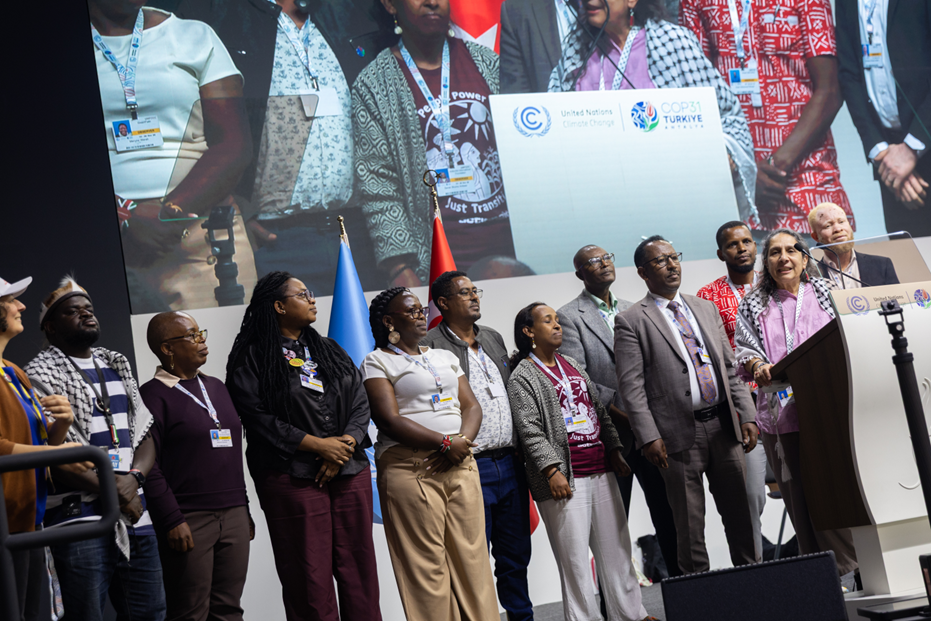
The People’s Plenary was one of the sessions held during the final days of the summit that brought visibility to the demands of civil society and communities affected by the climate crisis. Climate justice, moving away from fossil fuels, just transition and participation in decision-making processes were among the key themes.
COP31 and Türkiye: From Antalya to Implementation
Following COP31, the key agenda for Türkiye is how to translate the targets and initiatives highlighted at the summit into national policies and implementation. The energy transition, climate change adaptation, water security, forest protection, industrial transformation and access to climate finance are among the priority areas.
In the energy transition, renewable energy and electrification investments need to be expanded, emissions reductions in energy-intensive sectors accelerated, and resource efficiency in industry improved. It is important to support these goals with sector-based investment plans, implementation timelines and indicators for monitoring progress. The predictability of public policies and clarity of the regulatory framework are among the key conditions shaping the direction of private-sector investment in the industrial transition.
In climate change adaptation policies, water resource management and basin-level planning stand out. Companies, local governments and public institutions need to assess their data together and address water use, ecosystem needs and agricultural production within the same planning framework. Wildfires, risks in coastal areas and the resilience of agricultural production to climate impacts also require planning based on local data. Particularly in water-stressed basins, developing data-sharing and joint-planning mechanisms among public institutions, companies and local stakeholders could contribute to more accurate identification of environmental risks and investment priorities.
Access to climate finance, corporate governance and private-sector participation will also be decisive in delivering this transformation. It is important for companies to set targets based on reliable environmental data and reflect these targets in investment and supply chain decisions; for boards to monitor environmental risks; and for progress to be reported regularly. Financial institutions’ consideration of climate and nature-related risks in lending and investment decisions can also help support transition investments.
Developing project preparation capacity is also among the priorities for improving access to climate finance. For adaptation, energy transition and nature conservation projects, risks, investment needs, expected environmental outcomes and implementation capacity need to be clearly articulated. Reflecting national targets in sectoral strategies, local governments’ climate and adaptation plans, and companies’ investment programmes will be an important part of Türkiye’s implementation agenda following COP31.
Assessment for CDP Türkiye and Companies
The political deadlock at COP31 does not eliminate the need for companies to manage climate- and nature-related risks. CDP’s COP31 communications framework highlights three points: making environmental data usable in policy, investment and implementation decisions; translating national climate and nature targets into economy-wide transition plans; and strengthening the resilience of the shared systems on which economies and communities depend.
In 2026, CDP requested environmental data from more than 73,000 organisations worldwide; more than 23,100 organisations reported in 2025. In Türkiye, 151 companies reported in 2025. Of these, 45 featured on at least one CDP Global A List, while five companies received an A score across all three programmes: Climate Change, Water Security and Forests.
Nevertheless, reporting results need to be backed by concrete implementation. Companies need to integrate their climate and nature targets into investment plans, capital expenditure and supply chain decisions, and assess not only emissions reductions but also their impacts on water use, land management, deforestation and biodiversity. Boards’ integration of environmental risks into decision-making and regular monitoring of progress towards targets are also fundamental elements of this transformation.
It is also important for companies to take into account the environmental needs of the regions in which they operate. Developing cooperation with public institutions, local governments and other stakeholders, particularly in water-stressed basins, can help connect corporate environmental data with local needs and support the development of shared solutions.
CDP Türkiye’s COP31 Events
CDP Türkiye organised two events and participated in two events as part of COP31. News articles, video recordings and related reports can be accessed through the links below.
Events organised by CDP Türkiye
On 11 November, the report “Türkiye Corporate Environmental Outlook: From Disclosure to Delivery”, prepared in collaboration between CDP Türkiye / Sabancı University Corporate Governance Forum and UN Global Compact Türkiye, was launched at a panel held at the Türkiye Pavilion. The study assessed companies’ environmental performance, commitments and practices.
Links: Event article | YouTube recording | Report

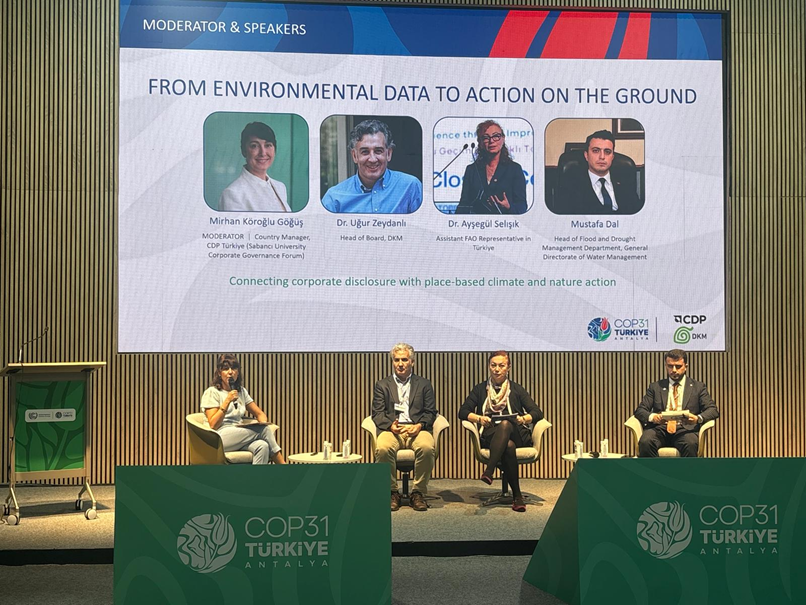
On 19 November, the report “From Environmental Data to Action on the Ground: Connecting Corporate Disclosure with Place-Based Climate and Nature Action”, prepared in collaboration between CDP Türkiye / Sabancı University Corporate Governance Forum and the Nature Conservation Centre (DKM), was launched. Bringing together reporting data from 151 companies and DKM’s field experience, the study addressed climate, water, biodiversity, forests and plastics.
Links: Event article | YouTube recording | Report
Events attended by CDP Türkiye
On 14 November, Mirhan Köroğlu Göğüş, Country Manager of CDP Türkiye, participated as a speaker in the panel “Women in Carbon: Empowering Female Leadership in Climate Markets”, organised in collaboration between Sabancı University and Çimsa. The panel addressed women’s career development and leadership in carbon- and energy-intensive sectors.
Link: Event article

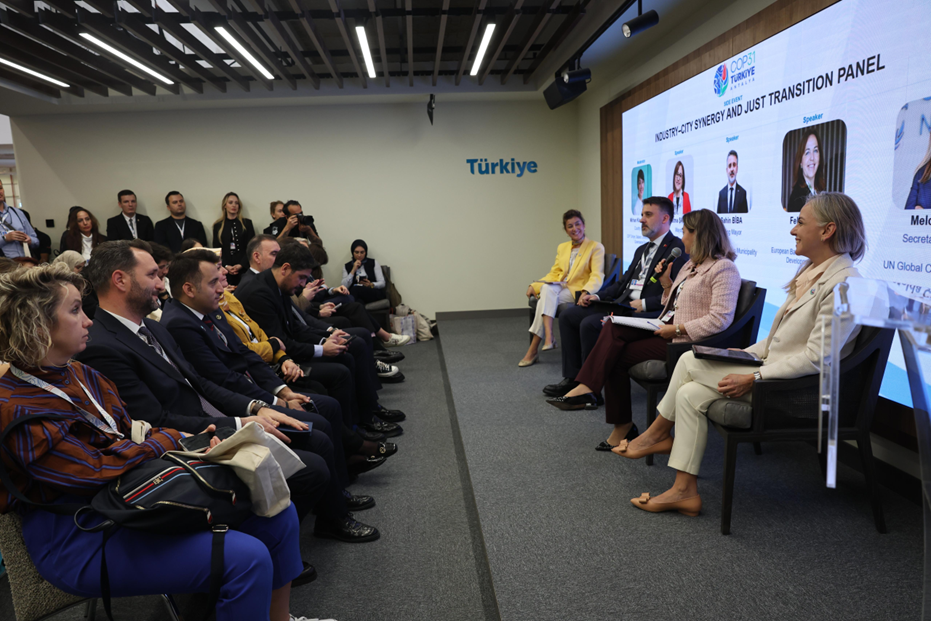
On 16 November, Mirhan Köroğlu Göğüş moderated the panel “Industry–City Synergy and Just Transition”, organised by Bursa Metropolitan Municipality at the Türkiye Pavilion. The panel discussed the green transformation of industry, the sustainable development of cities, employment, skills, and public-private sector cooperation.
Link: Event article
Conclusion
Although COP31 delivered progress on technical issues and introduced new initiatives, it failed to reach consensus on key political issues such as moving away from fossil fuels, climate finance and just transition. The impact of the targets raised in Antalya will depend on the extent to which they are translated into national policies, financing decisions and measurable implementation. For companies, reliable environmental data, transparency, and the integration of climate and nature targets into investment and business strategies remain important.
The summit produced technical outcomes such as decisions on carbon markets, guidance on indicators under the Global Goal on Adaptation, and the launch of the second Global Stocktake process. Initiatives announced in the areas of electrification, electricity grids and nature also set out steps to accelerate climate action across different sectors. However, the ability of these developments to produce tangible results globally will depend on countries implementing their commitments and providing the necessary financing.
Following COP31, countries’ priority will be to strengthen their national climate policies and accelerate implementation processes in line with the goals of the Paris Agreement. For Türkiye, it will be important to ensure continuity for the initiatives launched at the summit, reflect climate and nature targets in national policies, and support the active participation of the private sector in the transformation process.