
 ...
...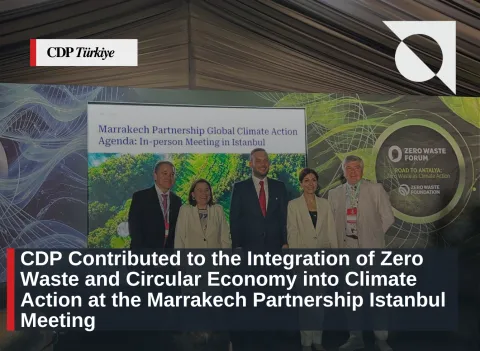
CDP Türkiye participated on behalf of CDP in the in-person meeting of the Marrakech Partnership for Global Climate Action, conducted under the framework of the United Nations Framework Convention on Climate Change (UNFCCC) and held in Istanbul. During the meeting, CDP contributed to discussions on integrating zero waste and circular economy approaches into the global climate action agenda.
The meeting, organized as part of the Zero Waste Forum by the Zero Waste Foundation, brought together the COP30 and COP31 Climate High-Level Champions, UNFCCC representatives, international organizations, city networks, civil society organizations, and stakeholders operating within the Marrakech Partnership. The primary objective of the meeting was to assess how zero waste and circular economy approaches could be more effectively incorporated into the implementation mechanisms of the existing Global Climate Action Agenda.
At the center of the discussions was the “Zero Waste for Climate Action Package” initiative, which was presented to stakeholders as a new framework proposal aimed at making zero waste practices and circular economy solutions a permanent component of climate action. The initiative envisages integrating practices such as waste prevention, reuse, repair, refurbishment, composting, and resource recovery into existing climate action mechanisms. It also seeks to bring together governments, cities, businesses, financial institutions, and civil society actors around a common implementation platform.
During the meeting, participants emphasized that a significant share of global greenhouse gas emissions is linked to resource use and waste management. It was noted that food loss and waste account for approximately 8–10% of global emissions, while methane emissions from the waste sector constitute around 20% of total methane emissions. In this context, zero waste and circular economy practices were recognized as important climate solutions that can contribute not only to emissions reduction but also to resilience, biodiversity conservation, and the achievement of sustainable development goals.
In closed sessions attended by organizations operating under the Marrakech Partnership, discussions focused on how the zero waste approach could be connected to existing climate action areas and what concrete outcomes could be carried forward into the COP31 process. Participants examined the links between zero waste and various climate action domains, including the energy transition, cities, resilience, biodiversity, food systems, and sustainable development.
As part of the program, working groups were organized around four main themes: Zero Waste, Food Security, Climate-Resilient Cities, and Youth & Education. Representing CDP Türkiye, Mirhan Köroğlu contributed particularly to discussions on cities and climate resilience, highlighting the importance of data-driven climate governance and multi-stakeholder collaboration.
The insights gathered during the meeting are expected to inform the future governance structure, priority work areas, and implementation mechanisms of the Zero Waste for Climate Action Package. The overarching goal is to establish zero waste and circular economy approaches as permanent pillars of the Global Climate Action Agenda and to strengthen implementation-oriented climate action in the lead-up to COP31.
As one of the stakeholders within the Marrakech Partnership, CDP remains committed to contributing to international collaborations that accelerate climate action and to sharing data-driven solutions that support private sector transformation on global platforms.