Submitted by irmak.sedef on June 18, 2025
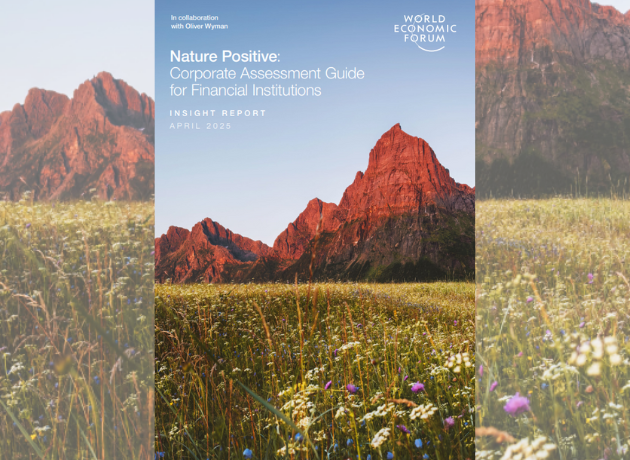
Financial institutions (FIs) are increasingly recognizing the importance of engaging with companies on their impacts on nature. As CDP, we are pleased to have contributed to the development of the report “Nature Positive: Corporate Assessment Guide for Financial Institutions,” prepared by the World Economic Forum (WEF) and Oliver Wyman. This report examines how financial institutions can use CDP data to assess the nature transition of companies in their portfolios and to track progress toward the goals of the Global Biodiversity Framework (GBF).
As of 2025, the nature crisis—deepening rapidly in parallel with the climate crisis—has evolved into not only an environmental issue but also an economic and social risk domain. The new report titled “Nature Positive: Corporate Assessment Guide for Financial Institutions,” prepared through a collaboration between the World Economic Forum (WEF) and Oliver Wyman, offers a comprehensive solution proposal to this critical agenda from the perspective of the financial sector.
Why Is It Important?
More than 50% of global GDP depends on nature. Despite this, the private sector invests only USD 35 billion annually in nature-positive activities, while investments harmful to nature exceed USD 5 trillion. Closing this gap requires a fundamental rethinking of the relationship between finance and nature. WEF’s guide provides precisely the technical infrastructure needed to initiate this transformation.
What Does the Report Offer?
The report details how financial actors—such as banks, insurers, and investors—can assess the impacts of companies in their portfolios on nature. The guide emphasizes that methodologies developed for climate transition plans should be extended to the nature dimension.
Nature assessment for financial institutions is addressed across three dimensions. To measure companies’ capacity for a nature-positive transition, the report proposes 11 key indicators across three main information dimensions:
Starting Point:
Have the company’s impacts and dependencies on nature, as well as its risks and opportunities, been identified?
Has a materiality analysis been conducted using frameworks such as TNFD LEAP or SBTN?
Ambition & Targets:
Does the company have long-term goals related to nature?
Are the targets science-based? Do they meet SMART criteria?
Transition Credibility:
Are nature targets integrated into company policies, governance structures, capital expenditure plans, and supply chains?
Key Indicators:
- Material nature impacts, dependencies, risks, and opportunities
- Nature metrics (e.g., water use, land-use change) *Nature vision and purpose
- Nature targets
- Strategy and action plans
- Policy framework
- Governance structure
- Performance-based incentives
- Planned expenditures
- Independent verification of actions
- Supplier engagement plan
Key Observations and Findings
-
Nature loss is an economic risk: over 50% of global GDP depends on nature.
-
Corporate nature transition plans are still at an early stage; however, frameworks such as TNFD, GFANZ, and SBTN are accelerating this process.
-
Regulations such as the European Green Deal, CSRD, CSDDD, and IFRS S2/ISSB are increasing financial institutions’ data needs related to nature.
Recommended Actions for the Financial Sector
Closing Data Gaps: Begin working with existing metrics available through platforms such as CDP, TNFD, and GRI.
Governance and Policy Alignment: Integrate nature metrics into ESG systems.
Engagement with Companies: Conduct deeper analysis and closer engagement, particularly in nature-intensive sectors such as agriculture, mining, and food.
Financial Product Development: Finance the transition through nature-sensitive bonds, insurance products, and blended finance solutions.
As nature-related risks become more visible within the financial system, investors and regulatory bodies are taking action. This guide offers financial institutions not only risk mitigation tools but also opportunities to create value through a nature-positive transition.
For a more just, resilient, and nature-aligned economy, nature assessment must become an integral part of your way of doing business. Now is the time to act.
Discover how to report with CDP in 2025: Disclosure Cycle 2025 – CDP
Click to access the full report: https://reports.weforum.org/docs/WEF_Nature_Positive_Corporate_Assessment_Guide_for_Financial_Institutions_2025.pdf